Me: "Hi, I'm Sharvan"
smiles, reaches out to shake hands
Her: "Hi I'm Tisha"
reciprocates smile, handshake handshake
thinks about the endless possibilities of what you could ask next.
what do i ask?? think think think
Me: "So…what do you do?"
uggrrhh…bad question, I don't even care about this!!
SO, WHAT DO YOU DO?
Is the most uninspired question you can ask someone 2 minutes after meeting them. It's an easy question everyone knows the answer to, but the real problem is not the question but how we treat the answer to this question we all seem to hate but unconsciously need to know.
Learning someone's profession provides an immediate shortcut to judge how we should approach them. It's the quickest way for us to gauge how society has evaluated this person, their economic worth, educational background, and presumed intelligence, all neatly packaged in a job title. People with prestigious or difficult-to-obtain jobs are automatically assumed to be smarter and ranked higher in our mental hierarchy of people in the room.
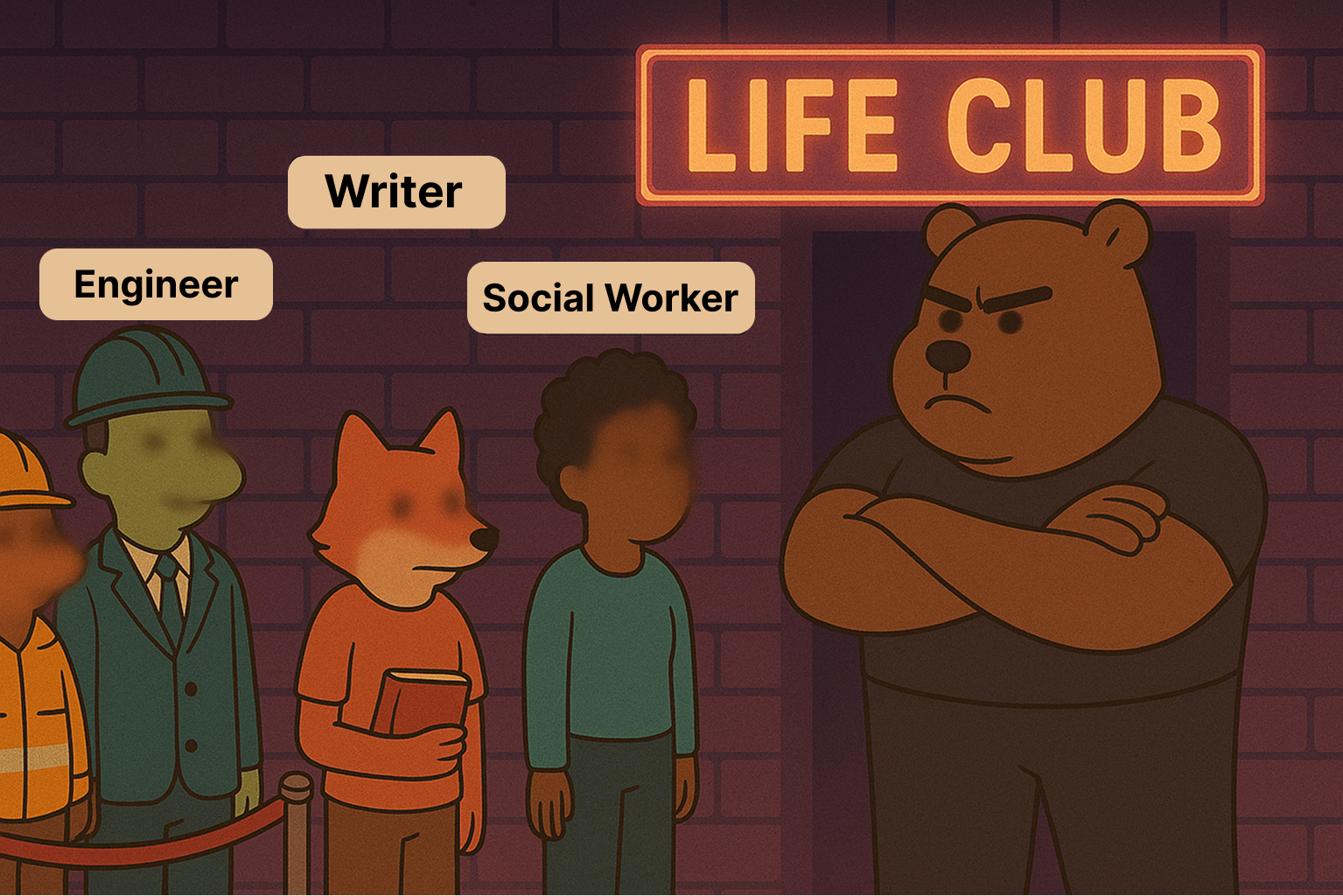
In the nightclub of life, we're playing bouncer, constantly checking status cards before letting people in.
The Hidden Sorting Game We're Playing
The question isn't just reductive, it's boring. It's almost as uninspired as discussing the weather on a first date. It bypasses genuine curiosity about who someone is and replaces it with what they do to pay bills.
Funny enough, there's one magical situation where this job-obsessed question mysteriously disappears: when we're trying to flirt. Nobody ever landed a second date by enthusiastically discussing their spreadsheet skills or their latest coding logic genius. Somehow, when there's even a hint of romantic potential, we suddenly remember how to ask about passions, dreams, and that weird hobby they picked up during lockdown. Amazing how the possibility of a kiss can make us forget all about corporate hierarchies, right? So at least some of us do know how to be interested in the person and not their profession.
It's interesting how we intuitively understand that professional identity is a poor foundation for romantic connection, yet we default to it in so many other social contexts. The difference highlights how we actually do know how to engage with people as complete humans when properly motivated.
Imagine if John Lennon had written: "Imagine all the people, sharing all their jobs" instead of "sharing all the world." The absurdity is immediately apparent—yet we've normalised reducing human complexity to job titles.
This creates a social shorthand where a consultant is deemed more conversation-worthy than a social worker, despite the latter providing more essential services. I'm not saying the social worker will definitely be more interesting, but building that opinion at the back of your mind will hamper your ability to build a real conversation that explores who they are as a person.
Has it occurred to you?
If someone's identity is closely tied with their jobs and the work they do, they will bring it up naturally. A topic that emerges organically like that will have much more to offer.
In the film "Before Sunrise," strangers Jesse and Celine develop profound intimacy through philosophical questions and personal stories—without ever focusing on their careers. Their connection forms through curiosity about life's bigger questions rather than professional accomplishments.
Consider this: if people genuinely love what they do professionally, it naturally bleeds into their personal life—you'll hear about it without asking directly. Similarly, if they hate their job, that too might emerge as the conversation develops. Either way, they'll share this aspect of their life if they believe it helps you understand them better.
Try This For a Week
Ban "What do you do?" from your conversation repertoire. Notice the different pathways discussions take when this conversational crutch is removed. You might discover that eliminating default questions creates space for deeper, more meaningful exchange.
Imagine if popular songs focused on occupation instead of emotion. Music would lose its transcendent quality. Similarly, our conversations lose their potential for meaningful connection when biased by professional identities.
So Next Time You Meet Someone New...
The next time you meet someone new, resist the urge to immediately categorise them by profession. Instead, be genuinely curious about who they are beyond their paycheck. After all, in the words of philosopher Martin Buber, meaningful connection happens in the space between "I and Thou"—not between job titles.
The "What do you do?" question isn't just boring—it's a missed opportunity. When we bypass status verification and approach each person with genuine curiosity, we create space for authentic connection.
The most interesting conversations, like the most beloved songs, transcend the mundane to touch something essentially human. A real conversation can become like a beloved song that brings back memories even when you hear some phrase or tune of it.
Just as we remember where we were when we first heard a song that moved us, we remember the setting, the feeling, the energy of conversations that truly mattered. And like songs that become the soundtrack to different chapters of our lives, meaningful conversations become markers in our journey—evidence that for a moment, we truly saw and were seen by another person.